Din hija blog li tikkonċentra fuq il-letteratura kemm Maltija kif ukoll barranija. Huma inklużi wkoll aċċenni għal ħwejjeġ interessanti marbutin mal-kultura. Ara wkoll il-blog tiegħi www.pagnawarapagna.blogspot.com għal reċensjonijiet u studji dwar kotba differenti.
Tuesday, December 23, 2008
Tislima lil poeta u kittieb minn Ghawdex

Monday, December 08, 2008
Nosside 2008 - Video by Stanka Gjuric
Part 2 - www.youtube.com/watch?v=i0Yh7sndjlY
Last part - http://www.youtube.com/watch?v=cS_6QIW_Xxc
A big thanks to Stanka. People who are interested in next year's competition please visit
http://www.nosside.com/
Tuesday, December 02, 2008
Poesia con Menzione Speciale al Nosside 2008
(Versione originale in maltese)
Ghad-dell ta’ sgajra mgennba
nara l-hajja tifrex quddiemi
wirja shiha ta’ affreski dinamici
waqt jum ta’ btala.
Fuq din il-firxa tila hadra
mijiet ta’ tfal u familji jinsgu
l-waqtiet sbieh taghhom.
Ir-roti hfief wahda wara l-ohra
u s-sewwieqa ckejknin imbissma
xuxthom bnadar ghar-raggi tax-xemx titbaskat.
Mad-dawra l-hsejjes kwotidjani ta’ dinja ccencel
ghal darba mistrieha minn toqol il-hajja
mill-uff u l-ajma tal-frosta ta’ l-arlogg.
Fil-gholi s-sema mcajpar jalterna
ma’ waqtiet intensi ta’ dija qawwija
u t-tajra terhi wrajha xija ta’ dnieb imlewna
u l-blalen bla heda joqomsu ’l fuq u ’l isfel
bhal atleti fuq trampolini
u l-vann tal-gelati jhabbar genna ta’ toghmiet
friski ghat-tfal ferhana.
Fuq din il-firxa tila hadra
mijiet ta’ lwien u strixxi kkuluriti
fin-nofs roqgha bajda u blu ta’ sorijiet
jigru henjin ma’ l-orfni...
Il-hin ghaddej u l-folla kielet u xorbot
u griet u dahket u laghbet
u tkellmet u xejret u ghajtet u ghajjiet
u ttewbet u strahet....
Ghad-dell ta’ sgajra mgennba
nara l-hajja tifrex quddiemi
u niftakar li xi darba anki dil-wirja
ghad izzarma u taghlaq.
Sitting under a shadowy tree
I watch life spread its arms in front of me
A solid demonstration of dynamic frescoes
during a day of rest.
On this wide green cloth
hundreds of young and not so young weave
their beautiful moments.
The bicycles speed away one after the other
and the young drivers smiling
their hair flags baking in the rays of the sun.
All around the daily sounds of a world ringing,
for once resting from life’s toll
resting from the “uff” and “ouch” of time’s lash.
High up the cloudy sky alternates
with intense moments of radiant light
and the kites let behind wakes of colourful tails
and the balls restless, bounce up and down
like athletes on a trampoline
and the ice-cream van announces a heaven of
fresh flavours for the happy children.
On this wide green cloth
hundreds of colours and colourful stripes,
in the midst a white and blue patch of nuns
who happily run with the orphans...
Time is ticking and the crowd ate and drank
and ran and laughed and played
and talked and waved and shouted and got tired
and yawned and rested...
Sitting under a shadowy tree
I watch life spread its arms in front of me
and remember that one day
curtains will be closing even on this spectacle.
Free translation by the author himself
je regarde la vie étendre ses bras devant moi
une démonstration continue de fresques vivantes
durant une journée de repos.
Sur cette nappe verte et étendue
des centaines de jeunes et de moins jeunes tissent
leurs agréables moments.
Les bicyclettes défilent les unes derrière les autres
et les jeunes automobilistes sourient
leurs cheveux au vent brûlés par les rayons du soleil.
Entouré des sons quotidiens d’un monde en éveil
pour une fois les bruits de la vie se reposent
se reposent des « ouille » et des « aie » de ses coups.
Là-haut, le ciel nuageux alterne
avec des instants de luminosité rayonnante
et les cerfs-volants trainent leur queue colorée
les balles rebondissent continuellement
comme des athlètes sur un trampoline
et le vendeur de glaces déclamant
ses parfums aux enfants heureux.
Sur cette nappe verte et étendue
des centaines de couleurs et de zébrures colorées
se détachent des religieuses de bleu et blanc vêtues
courant joyeusement avec des orphelins…
Le temps passe et tous ont mangé et bu
et couru et ri et joué
et bavardé et gesticulé et crié et ont été épuisés
et ont baillé et se sont reposés…
Assis à l’ombre d’un arbre
je regarde la vie étendre ses bras devant moi
et me souviens qu’un jour
le rideau se fermera sur ce spectacle.
Traduit par Catherine Milet
Sentado en la sombra de un árbol,
miro a la vida extendiendo sus brazos delante de mí.
Una manifestación sólida de frescos dinámicos
en un día de descanso.
En esta tela amplia y verde
centenares de jóvenes y no tan jóvenes tejen
sus momentos bellos.
Las bicis se van rápidas, corriendo una detrás del otra
y los ciclistas sonríen,
con su pelo cociendo como banderas en los rayos del sol.
Todo alrededor, los sonidos diarios del mundo se oyen,
descansando por una vez del daño de la vida,
descansando del Ay y del Uff del látigo del tiempo.
En alto, el cielo nublado alterna
con momentos intensos de luz radiante
y las cometas desprenden huellas coloridas en el cielo
y las pelotas sin descansar, rebotan hacia arriba y hacia abajo
como atletas en un trampolín
y la furgoneta del heladero anuncia un paraíso de frescos sabores
para los niños contentos.
En esta tela amplia y verde
centenares de colores y rayas coloridas
en medio de una mancha blanca y azul de monjas
corriendo alegremente con huérfanos…
y el reloj nunca se para y la multitud comió y bebió
y corrió y rió y jugó
y habló y saludó y gritó y se cansó
y bostezó y se descansó…
Sentado en la sombra de un árbol
miro a la vida extendiendo sus brazos delante de mí
y me acuerdo que un día
las cortinas también cerrarán este espectáculo.
Traducción el español de Stephen Cachia
Winners at the Nosside 2008 (Reggio)
Bottom left: Patrick Sammut (first from left, with other winning poets of Nosside 2008, at the Archaeological Museum of the Magna Grecia, Reggio).
Bottom right: Patrick Sammut being given his prize during the Ceremony at the Local Council of Reggio.
Nosside is an international poetry competition open for all countries from all over the world. Participants send their poetry written either in one of the five main languages (Spanish, French, English, Portugese, Italian) or in their native language (or dialect), with a translation in one of these five languages.
This year Nosside hosted 40 participating countries, 29 languages in all. There was one overall winner from Italy , four other winners and then 10 special mentions. Sixth Form teacher and poet Patrick Sammut featured among these last 10, with a special mention for his poem written in Maltese, Jum ta’ Btala, and translated into English as A Day ofRest.
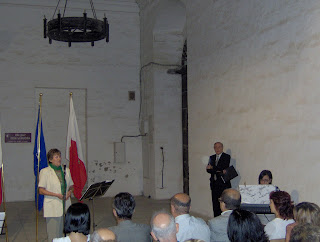
The prize-giving ceremony was held on Friday, 28th November, at the Reggio Local Council. Poets from all over the world ( Italy , Brazil , Venezuela , Mexico , Colombia , China , Russia , Croatia , Congo , Malta ...) met and read out their winning poem.
Before the ceremony the group of poets, together with Prof. Pasquale Amato (the mind behind Nosside) were interviewed on Reggio TV. They also had the opportunity to visit the Archaeological Museum of the Magna Grecia in Reggio, where one can admire the world-famous Bronzi di Riace. In the evening they were treated to a superb Italian dinner in a restaurant nestled in the nearby hills. On Saturday morning a Seminar was held in Messina , where the poets discussed Cultural Differences and Poetry. Mr Sammut was given a silver plaque, together with a certificate commemorating the occasion.
Monday, November 03, 2008

Some days ago I received a very interesting book from Dr. Ioannis V. Menounos from Greece. The book is When Paul met Socrates - A discussion involving a number of people in Athens in 52A.D. (Alexander Press, Montreal, 2008). It is a 70-page book based on the Socratic dialogue where Menounos imagines Saint Paul meeting Socrates (two men who lived more than four centuries apart) in the present day. It is a spiritual encounter. I read it all at once as the style is flowing and the arguments treated are clear although deep. I have to read the book a second time as I want to reflect more on the situation created by the author.
Ioannis V. Menounos was born in Athens, Greece, where he graduated from the Philological School of the University of Athens with specialization in Neo-Hellenic Studies. He worked for 25 years as a teacher and principal of public high schools, obtaining his Ph.D. in 1980 for his work on the life and teachings of St. Cosmas the Aitolian. Author of 25 books, his writings include a synoptic history of the Greek nation, many monographs on St. Cosmas, novels, treatises and short stories. He was the editor of the newspaper "Dimosiographiki" for 21 years.
Friday, October 24, 2008
A poet from Romania - Study and interview

The poetry of Nadia-Cella Pop
(After reading poems in English and Italian in The Lordship of the Word)
Language, poetic mechanisms and other interesting aspects:
Reading the poetry of Nadia-Cella Pop is quite an experience. Hers is a very powerful imagery and at the same time beautiful and lyrical. Pop’s poetry is also a game on words which when read forces the reader to exclaim, “How beautiful!” Hers is a language which goes directly to the heart. All is presented in an aura of mystery. The poet is well-tied to the present but her fantasy travels back and forth in time with great ease, as with much ease she creates very effective imagery. She also travels between two different temporal points in time which mark the limits of Pop’s fantasy: at one extreme, “a world of ruins” (the extreme point of corruption), and on the other extreme, a world where “rule the butterflies” (a world of innocence, untouched). Hers is a voice in a way tied to the present, but in other ways it surpasses the limits of time. Pop’s stature at times reaches dimensions that surpass “all the worlds we know”.
In writing her poetry Nadia-Cella Pop makes use of different lexical registers such as nature, music, colours, emotions and the Bible (the crucifix is a recurring image).
Reading the poetry of Nadia-Cella Pop is also a voyage from childhood to old age, with all that is experienced in between.
Themes:
Nadia-Cella Pop sings about love, peace and harmony through her word. In The Afternoon Tea she invites humankind to unite. Harmony is the key word, and all this in a simple but very fluent language. Harmony is also the thing common to both life and music. Human love later on transforms itself into a pantheistic love where the “I” unites “with the world of worlds for eternity”.
The poet invites the reader to reflect on huge (the macrocosm) and small (the microcosm) things, on the good and the evil, on the strong and the weak, on the conquerors and the vulnerable. Pop writes about the worlds both within (memory and emotions) and without (creation and nature), the told and the untold. Nature is seen as an open book from where the poet learns, reflects and expresses what people in general have no time to say.
Little gestures or things, like having a cup of coffee in the morning or a flower, inspire Pop to write about universal experiences, thus those lived by man and woman not only in Romania, but everywhere. In this way Pop manages to change gestures into words and words into poetry. Like the mime, the poet does not speak but makes us see what “we want to forget about ourselves”. Pop also helps us move always nearer to the “deciphering of the total”. And this can only happen through “pure thought and a virgin soul”.
And this makes us feel that her poetry is also an invitation to “remain forever children”, and to continue to feel the need for fables and adventure.
Pop also writes about the tiredness of the body and the grandeur of the spirit. However, part of this grandeur belongs also to poetry.
NADIA-CELLA POP ANSWERS MY QUESTIONS:

1. Why does the poet feel the need to publish his poetry in different languages and in different publications, local and foreign?
For all I know, the poet turns the usual words into artistic expressions, by giving them value and exquisite harmonies, offers a unique profoundness for feelings and visions with an endless horizon.
His/her thrills and imagination, illustrated by a multifarious gamut of imagery can reach to the readers’ souls, only if the lines are arranged on the “stave” of readers’ language.
And if the translations preserve the message and musicality of the lines, the triumph of emotional communication is guaranteed.
2. How important is it for you to have contacts with other poets, even foreign ones?
My contact with foreign poets is something of great value because of the exchange of literary ideas and realization about other creators’ opinions about personal and general struggles, in an era which is “strangled” by plenty of information and “the race of know-how, using only the most exact news” or by cold pragmatism.
Today, the poets are very anodyne or very rare, it’s all about the lyrical consumers’ pretensions, their desire to get thrilled by poetry readings, about how they can identify themselves with poet’s mood or to be mobilized to choose their life principles.
3. What do you consider most important: poetry for art’s sake, or poetry with a message?
Poetry must have a message, must be suggestive, bearing a huge area of human situations and “voices” of nature, all connected with feelings and with involvement of the divinities in the human “environment”.
All these quests must wear artistic forms, otherwise they remain in the zone of insignificant and mundane language. The art and social life must stay together.
I think the main sense of the word in a poem needs to be thoroughgoing, but not hidden, because in that case it disturbs the real sense of the message. The musical suggestion of the poetic speech leads towards essences and unknown inner vibrations.
4. What are the themes you write about in your poetry?
The themes of my poetry are provided and directed by my contemplative and philosophical structure within, of what I personally feel about events and moods. They were enriched by other people’s experiences and my vast cultural background. So, my books contain erotic poems, patriotic poems, poems with a mystic sense, where the intensity of feelings rules, poems of existence. I always respect the words’ aesthetics. I’m tracking a coherent base thinking about all types of readers, to let them taste the originality of my lyricism.
5. At what time and in what environment do you usually write poetry?
Poetry is about to be settled on the blank paper when the inspiration takes the poet’s soul by storm, when the anxiety turns into artistic expression of wisdom. And then, all the things around vanish and the space is haunted by inner voices, emotions and feelings that become marks and senses, links of the same chain in poems. The confessions and abstract thoughts of the poet need silence, that is created by areas in the dark or peaceful nature’s charm in the daylight. Of course, this is my personal opinion…
6. How do you react to people saying that the poet is only a dreamer?
I can’t be angry when someone says the poet is only a dreamer. In part it is true. The dream’s paths leads us to realms beyond our possibilities, at least as an idea, and the excessive sensitivity might raise imagery and visions of a rare beauty. But the poet could be a militant for justice and truth, a fighter of mankind’s treasures. The dreamer is romantic, passionate, picturesque, a thinker of profoundness. The dreamer’s flights are powered by imagination.
7. Your poem “The Afternoon Tea” made these questions come into my mind: what do poets and politicians have in common? How do they differ?
My poem “The Afternoon Tea” has the romantic purpose to gather together all mankind and a possible contact with the possible worlds in the outer space, due to the friendly inner rhythm of our global harmony.
I don’t think the poets and the politicians have something in common, they just live under the same sun, that’s all. While the politicians think and act for the benefit of their own clique of interests, using often “the trumpet of democracy” for many of their selfish actions, the poets unveil a world of questions, hyperboles, senses, touching suggestions, without reaching the border of theories, rules, percepts and laws. The poet remains to rule the world of metaphors.
8. The poet is someone who lives with his feet well rooted to the ground but also somebody who looks at mankind and the world from high above. What does Nadia-Cella think about this?
The poet should be a “symbiosis” between a person who lives on Earth, our beautiful planet, and another person who can climb the peaks of aspirations, imagination, majestic ideals that are waiting to be discovered and given, out of the personal retort, to the sensitivity and understanding of all the people. But, all without any seclusion or vanity from the poet.
The new reality, which the poet created this way, will be artistic and positive.
9. What does poetry have to do with love, nature and discovery, according to Nadia-Cella?
Love, that moves all the beauties of human soul, nature, that brings us harmony, protection, dangers, the discovery of all phenomena, events and quivers that give emotions to human beings, all mean the ideas which are directed by the muses to poets (bards), the real parents of life’s anthems.
10. Reading the poem “A Cry” in “a world of ruins” can poets be considered as the ruling “butterflies”?
In the poem “A Cry” I did not think of poets like “ruling butterflies”. But, after a possible apocalypse, some fragile life forms, as the butterflies might survive. So, there is hope, even little, in the splendour of a new beginning. One with gentle forms and multiple colors, charming…
11. Describe Nadia-Cella Pop as a person. Describe the city you live in, Brasov. Does Romania inspire you to write poetry? How?
Honestly, I wish to be described by others as a person, maybe by people who know me since a long time. I’d like to be considered as a sociable person, the one with the sense of honour, sympathetic, a woman with principles, joyous and full of compassion for the unlucky or unhappy ones. I hope that people around me appreciate my tact, wisdom, kindness or courage, even if I respond impulsively to impudence, lies, meanness, offensive behaviour or treason. I try to increase the good things inside me, despite other things.
Brasov, a former fortified city in Transylvania, located in Tara Barsei, is an old settlement, presented in documents since 1235; it has been settled by isolate communities since prehistoric ages. ARIUSD, my birthplace, a small village located some kilometers north from Brasov, is famous because of its neolithic settlement, so-called “Ariusd-Culture” (exquisite painted pottery). This is a reason for pride for me.
Of course, the ancient inhabitants of the city, the Dacians and the Daco-Romans lived and rode on the paths of history in the defense and development of this city. There were craftsmen, traders, artists, even artists and scholars.
Located at the foot of Mount Tampa, Brasov has beautiful landscapes of wilderness, which the tourists and locals like much. The areas of natural charm are in the neighbourhood of monuments, historical sites, cultural institutions and churches. The scientists and researchers find Brasov as a rich source and the people who like the arts and beauty think the same.
As many other creators (using words, notes, painting brush or carver’s chisel), I’m nourished by the inspiring springs offered by my country: history, places in the wild, other people’s experiences, the interferences of my own feelings. Any human involvement is a condition for a vast gamut of ideas and emotions, which I want to use as best I can, in my poems.
Thanks Nadia-Cella Pop :-)
Sunday, October 19, 2008
Joe Axiaq - Poeta Malti mill-Awstralja
.jpg)
Joe Axiaq twieled iz-Zebbug Ghawdex u emigra lejn l-Awstralja fl-1974. Ta’ 21 sena fil-bidu tal-qawmien multikulturali fl-Awstralja nghaqad ma’ l-ewwel grupp ta’ xandara fuq Radio 3ZZ fil-bidu tax-xandir tal-programmi Maltin fl-Awstralja, waqt li beda x-xoghol fl-amministrazzjoni manigerjali tieghu ma’ Telecom Australia u kompla bl-istudju u t-tahrig fl-amministrazzjoni, fil-gurnalizmu u fix-xandir. Kien involut fit-twaqqif ta’ l-ewwel grupp li kien jigbor fih iz-zghazagh Maltin f’Victoria, ghal attivitajiet rikreattivi u kulturali. Fl-1979 kien involut fit-twaqqif tal-Maltese Literature Group fl-Awstralja. Joe beda jikteb ta’ eta` zghira ghall-programmi tat-tfal fuq ir-Rediffusion. Huwa kompla bix-xoghol tar-radju fuq Radio 3EA, illum SBS Radio, bhala gurnalista, xandar, producer u traduttur. Illum huwa n-National Executive Producer tal-Programmi Maltin kollha li jixxandru fuq l-SBS minn Melbourne u Sydney kuljum. Ghar-radju kiteb ghadd kbir ta’ novelli, stejjer, radjudrammi, features u dokumentarji. Ix-xoghlijiet letterarji tieghu jinstabu f’ghadd ta’ antologiji Maltin, rivisti u gazzetti ppubblikati Malta u l-Awstralja..
Huwa mizzewweg lil Elizabeth, Awstraljana ta’ nisel Malti u ghandu zewgt itfal, Catherine u Bernadette.
1.X'inhi r-relazzjoni ta' Joe Axiaq u l-Awstralja llum? Xi tfisser Malta ghal min jinsab fil-pozizzjoni tieghek?
Twelidt u trabbejt f’ambjent tipiku Għawdxi fir-rahal taz-Zebbug li sas-snin sebghin tas-seklu l-iehor kienu ghadu kif hallewh missirijietna u nannieta tal-qedem, f’razzett li min-naha wahda tara l-bahar u l-bajjiet sbieh tax-Xwejni u Marsalfron u fuq in-naha l-oħra l-widien u l-ghelieqi jhaddru taht l-gholjiet tad-Dabrani u Ta’ Kuljut. X’kuntrast mal-belt ta’ Melbourne bil-hwienet, restoranti u n-negozju u l-kummerc ta’ kuljum, fejn ilni nahdem għal dawn l-ahhar tletin sena u s-subborgi ta’ l-istat vast ta’ Victoria bi triqat twal u wesghin li jihduk sa l-ibghad trufijiet li ma jwasslu ghall-imkien. Ghawdex li hallejt aktar minn tletin sena ilu huwa Ghawdex tal-kartolini:
Meta mix-Xwejni
titla’ t-telgha taz-Zebbug
minn fuq il-Ponta t’Ghajn Melel
thossok tistrieh
u ghajnejk taghlaq
f’genna ta’ l-art miflug.
(Minn Mix-Xwejni ghaz-Zebbug)
Midhla ta’ Malta u Ghawdex tal-lum bit-tibdil u l-progess li sar b’xi zjara kultant u nzomm ruhi aggornat bil-mezzi komdi tat-telekomunikazzjonijiet tal-lum u anki permezz tax-xoghol gurnalistiku tieghi, fuq il-programmi tar-Radju ta’ l-SBS li wiehed mill-ghanijiet huwa li jzommu lill-Maltin ta’ l-Awstralja aggornati b’dak li jkun ghaddej fil-gzejjer Maltin. Ghalija li ghext aktar min-nofs hajti barra minn Malta, f’pajjiz mimli rizorsi u opportunitajiet, aktar ma jghaddi z-zmien aktar naffaxxina ruhi dwar kif dan il-poplu fuq gzira zghira, mix-xejn gharaf johloq ghejxien ghal uliedu, generazzjoni wara l-ohra u llum huwa pajjiz sovran bi stil ta’ hajja ma’ l-aqwa fid-dinja. Malta ommi, l-Awstralja marti, illum facli tinfired mill-mara, imma m’ommok ma tinfired qatt.
2. F'liema attivitajiet jew ghaqdiet jew inizzjattivi inti impenjat fil-prezent?
Minhabba x-xoghol tieghi bhala National Executive Producer tal-programmi Maltin fuq ir-Radju ta’ l-SBS li jxandar programmi Maltin kuljum ghall-komunita Maltija ma’ l-Awstralja kollha, ma nista’ nkun impenjat direttament ma’ l-ebda ghaqda jew organizzazzjoni partikulari li ghandna hafna minnhom fil-komunita’ Maltija fl-Awstralja. U fl-istess hin b’xi mod jew iehor inzomm kuntatt kontinwu mal-ghaqdiet kollha permezz tal-informazzjoni li nghaddulhom fil-programmi taghna ghas-semmiegha taghna. Ahna qeghdin hemm ghal kulhadd biex nitkellmu u nahdmu id f’id ma’ dawn l-ghaqdiet u l-organizzazzjonijiet li jkollhom xi haga xi jwasslu lis-semmiegha tagħna. Is-sejha ta’ dawn l-ghaqdiet bhalissa hija li jridu z-zghazagh. Il-bicca l-kbira tal-mexxejja ta’ dawn l-ghaqdiet huma mdahhla fiz-zmien u m’hemmx min jiehu posthom.
3. Fil-belt fejn tghix, il-Maltin, u komunitajiet ohra, jiehdu interess fil-letteratura?
L-interess mill-Maltin fil-letteratura fl-Awstralja huwa limitat fis-sens li m’hemmx apprezzament bizzejjed ghal dik li hija letteratura propja. Ghal bicca l-kbira tal-Maltin fl-Awstralja, il-letteratura hija poezija li taqbel jew xi storja li tbikki jew iddahhak. Hemm socjetajiet ta’ qari u kitba letterarja Awstraljani li huma serji u li minnhom tista’ titghallem hafna. Imma bhala komunita` Maltija ghadna ‘l boghod hafna minn dan. Issib membri f’dawn is-socjetajiet Awstraljani, ulied it-tieni u t-tielet generazzjoni li tkun taf li huma ta’ nisel il-Maltin minn kunjomhom biss, ghax jiktbu biss bl-Ingliz u ma jzommux kuntatt mal-komunita` Maltija.
4. Min huma l-kittieba Maltin fl-Awstralja llum? Xtahseb dwarhom u x'qed jinkiteb minnhom?
Il-kittieba rilevanti Maltin fl-Awstralja huma ftit. Dawn huma kittieba li f’Malta diga` kienu bdew jippubblikaw u ghamlu certu isem. Dan in-numru ta’ kittieba qed dejjem jonqos minhabba l-eta` u ghalhekk dawk li fadal jinghaddu fuq l-idejn. F’dawn l-ahhar hamsa u ghoxrin sena jew aktar nistghu nghidu li ma kellniex minn dawn il-kittieba li emigraw minn Malta. Dawn il-kittieba dejjem komplew jiktbu, ghalkemm forsi mhux dejjem jippubblikaw. Matul iz-zmien kien hemm ghaqdiet jew gruppi Maltin, li kienu jhaddnu whud minn dawn il-kittieba. Illum hafna minn dawn il-kittieba jahdmu wahidhom fis-skiet. Tajjeb li jkollok ghaqdiet li jigbru u jlaqqghu lil dawk li jhobbu u ghandhom ghal qalbhom il-letteratura, minghajr ma jimtlew l-imhuh li ghax wiehed jidhol f’ghaqdiet bhal dawn isir kittieb jew poeta. In-numru zghir ta’ kittieba/poeti rilevanti, qeghdin johorgu kotba ta’ poeziji, rumanzi, u ricerka bil-Malti u bl-Ingliz li huwa inkoragganti hafna.
5. Xi tghid dwar il-programmi radjufonici u anki l-gurnali tal-Maltin fl-Awstralja?
Jien in-National Executive Producer tal-Programmi Maltin li jixxandru fuq ir-Radju ta’ l-SBS li jinghata fondi mill-Gvern Awstraljan biex ixandar nazzjonalment mal-Awstralja kollha programmi bi 68 lingwa fosthom bil-Malti. Ahna ghandna programmi ta’ siegha kuljum li jixxandru mic-centri taghna ta’ Melbourne u Sydney, b’xandara u gurnalisti Maltin impjegati fiz-zewg centri. Il-programmi jinkludu bulettini ta’ ahbarijiet ta’ Malta, l-Awstralja u l-kumplament tad-dinja, intervisti ma’ personalitajiet Maltin minn Malta u l-Awstralja dwar suggetti topici, features u ahbarijiet kurrenti, dak li jkun ghaddej fil-komunita’ Maltija fl-Awstralja, programmi talkback ecc. Il-Maltin qatt ma jixbghu jisimghu dwar dak li jkun qed isehh fil-gzejjer Maltin. Sfortunatament iz-zghazagh, ulied it-tieni u t-tielet generazzjoni m’humiex interessati fi programmi ta’ din ix-xorta. Anki t-taghlim tal-Malti fl-Awstralja wasal biex jispicca ghax m’hemmx interess bizzejjed; ghalhekk anki jekk ikunu jridu jisimghu l-programmi bil-Malti lanqas jifhmu x’ikun jinghad. U ghall-Maltin li ilhom hawn aktar minn erbghin sena, jghidulna li lanqas qeghdin jifhmu l-Malti standard li nitkellmu (specjalment fl-ahbarijiet) tant tbieghdu mir-realta ta’ Malta tal-lum u tal-lingwa Maltija li kompliet tevolvi.
Hemm programmi Maltin ohra fuq hafna stazzjonijiet komunitarji mxerrda fl-istati kollha tal-Awstralja li jsiru minn voluntiera. Dawn aktar huma programmi hfief. Gazzetti ghandna wahda biss, li tohrog darba fil-gimgha, li wkoll tinstab f’diffikulta` minhabba l-ispejjez li tirrekjedi u n-nuqqas ta’ sapport mill-komunita`.
6. Liema hija l-belt li tghix fiha? Iddeskrivi t-tajjeb u l-hazin taghha?
Jien nghix fl-istat ta’ Victoria, u nahdem fil-belt ta’ Melbourne, belt kbira u sabiha, kosmopolitana, b’gonna kbar pubblici u c-centru tan-negozju u l-kummerc, b’opportunitajiet ghal kulhadd li trid tistinka ghalihom. B’kuntrast man-nies ghaddejja mghaggla ghax-xoghol jew biex jilhqu t-trejn, it-tallaba bil-qieghda f’xi kantuniera jew xi zaghzugh li jwaqqfek ghal xi dollaru jew sigarett:
Iz-zaghzugh tallab
fit-toroq ta’ Melbourne
jipprova jwaqqaf
lil kull ikun ghaddej
u n-nies liebsa puliti
ghall-ufficcju
jibqghu ghaddejja
qisu m’hu xejn;
u jghaddi ragel jitlob
f’halqu biss sigarett
u x’hin iz-zaghzugh waqqfu
nifs qasam mieghu… tnejn.
(Iz-Zaghzugh Tallab)
Melbourne, hija belt maghrufa ghall-facilitajiet sportivi u kulturali matul is-sena kollha. Fis-sajf tkun mimlija vizitaturi minn madwar id-dinja ghal-loghob tat-tennis u l-krikit u mbaghad ghall-grand prix tal-karozzi. U fix-xitwa t-teatri mdawla b’shows muzikali u b’kuncerti popolari u klassici li jattitraw nies minn kull rokna tad-dinja. Is-sigar kbar tal-gonna u matul it-toroq wiesgha jibdlu l-kuluri u jinzghu u jxiddu l-weraq, fuq l-isfond dejjem griz tal-bini gholi matul kull stagun u ma’ kull tmiem ta’ wiehed hemm il-bidu ta’ hajja gdida bis-sabih taghha. Hija belt ta’ kuntrasti fejn tara eluf ta’ nies u tista’ thossok wahdek, fejn tidra taghraf in-nies bla ma tkun tafhom, fejn ix-xitwa tidhol bla mistennija f’gurnata sajfija u qabel tilhaq tilbes il-kowt ix-xemx terga’ tisreg.
7. Xi tghid dwar ir-relazzjoni bejn il-kittieba Maltin fl-Awstralja u dawk f'Malta? Hemm rabta ta' xi tip?
Personalment, ir-relazzjoni tieghi mal-kittieba Maltin hija tajba hafna. Dejjem sibt ghajnuna, kooperazzjoni u interess kull meta kelli kuntatt ma’ kittieba u poeti Maltin. Permezz tal-programmi tieghi fuq ir-radju kelli l-opportunit¿ li nintervista ghadd ta’ kittieba u poeti matul iz-zmien. Pjuttost huwa min-naha tieghi li minhabba x-xoghol ma nzommx kuntatt bizzejjed. Kull meta bghatt xoghlijiet ghall-pubblikazzjoni f’pagni letterarji, rivisti u antologiji dejjem ixxandru. Donnu hawn grupp zghir ta’ kittieba/poeti fl-Awstralja li jqisu ruhhom ma’ l-istabbiliti f’Malta u li jidhrilhom li ma jinghatawx gharfien bizzejjed f’Malta. Min-naha l-ohra nahseb li jkun interessanti li xi hadd barra l-Awstralja xi darba jhares u jistudja b’mod objettiv lejn din il-kitba bil-Malti fl-Awstralja u l-izvilupp tal-lingwa Maltija f’dan il-kontinent.
8. Fil-qosor, liema huma l-publikazzjonijiet fejn dehru l-kitbiet tieghek?
Ko-awtur tal-ktieb tal-poeziji Bejn Vjagg u Iehor (1979), selezzjoni varja ta’ poezija u proza tieghi tinstab fl-antologiji ppubblikati fl-Awstralja, Irjieh (1986) u Frott iehor (1992) u l-antologiji ta’ l-Ghaqda Letterarja Maltija Xrar (1992), Spirali (1997), Mal-Mewga taz-Zmien (2001) minbarra f’ghadd ta’ rivisti letterarji u Pagna Letterarji tal-gazzetti Maltin.
------
Poeziji ta’ Joe Axiaq
MIL-LISTA TA’ TELEFONIJIET
Mil-lista ta’ telefonijiet
b’magenbhom l-ismijiet
fid-djarju personali
illum aktar ningassa
u l-godda… ftit specjali
ghax aktar ufficcjali
fid-djarju personali
u l-qodma qed jisfaru
mhux cari
bhal dari.
Joe Axiaq
Lil Ommi Fis-Smewwiet
Il-poeżiji mtawla
li kont tafhom bl-amment
għallimtni b’dal-lament;
u kbirt u tlaqt minn darek
żagħżugħ wild l-għanja Għawdxija
biex ngħix il-poeżija
fil-bidu tar-rebbiegħa.
Hemm poeżija storja
li għadni ngħix illum
ta’ tifel jitlaq daru
u mill-bogħod ommu kuljum
tindokra l-passi tiegħu
ta’ tifel ma jikbirx
u tgħallmu l-poeżija
u kelma ma tlissinx,
u qatt iżjed minn issa
li mortli s-smewwiet
ma tgħasses sewwa fuqi
fis-serħ ta’ dan is-skiet
u ttenni l-poeżija
li ddawwal dil-mogħdija
li għad twasslni ħdejk
biex qatt fuq ħaddejk sielma
ma nara d-dmugħ li bkejt.
Joe Axiaq
IT-TFAL TELQU BIL-VAPURI
(Wara li qrajt ir-rumanz ta’ Oliver Friggieri, It-Tfal Jigu bil-Vapuri.
Lil dawk il-Maltin u Ghawdxin li kellhom jitilqu Malta fuq il-vapuri,
ghal hajja ahjar).
Ommha qaltilha
li t-tfal jigu bil-vapuri
u stenniet it-tfajla
l-vapuri jidhlu x-xatt
u dahal vapur u iehor
u ghaliha tfal
ma kellhom qatt;
sakemm habbet zaghzugh
u taha tifel u tifla tnejn
u kienu l-ghaxqa t’ommhom
sakemm kibru u nizzlithom
darba x-xatt
u gie vapur hadhomlha lejn l-Awstralja
u izjed ma rathom qatt.
Joe Axiaq
FIT-TOROQ TA' MELBOURNE
Fit-toroq ta' Melbourne
jorqod it-tallab fqir
ihares 'il fuq fil-bini jilhaq is-sema
bil-kwiekeb ileqqu
jaqbzu f'muniti ta' zewg dollari
mill-oghla sulari
u ma jarax id-dollari
jaqbzu mill-but imtaqqab
u jduru tond madwaru
ta' min ghaddej fit-triq ghal daru.
Joe Axiaq
Jekk darba
Jekk darba tkun poeta
bla linka u klamar
u biex tikteb poeżija
demmek tuża bħan-nar,
ikteb ftit versi qosra
bħal dawn li llum qed taqra
qabel tħossok tiddgħajjef
u taqa’ stordut
bħal f’sakra
u tpoġġix il-karta xuga
minn fejn id-demm jisponta
flok it-tajjara bajda
li d-demm ftit ftit tiskonta.
Joe Axiaq
Sunday, October 12, 2008
Messagg ghal Jum il-Poezija 2008

IL-POETA-PROFETA
Uhud aktarx jabbinaw il-kelma profeta ma’ bniedem li jbassar il-gejjieni. Forsi ghax fl-Antik Testment il-profeti kultant kienu jaghmlu dan. Izda l-verita`, it-tifsira ta’ profeta hija ghalliem.
Ghalhekk, il-poeta tradizzjonali kien u ghadu l-ghassies tas-socjeta`; u hekk ghandu jkun. Importanti jsegwi l-grajjiet li jsehhu madwaru, u fejn jinnota nuqqasijiet ghandu jhossu fid-dmir li bi prudenza kbira jiftah halqu u jsemma’ lehnu.
Hekk ghamlu fl-imghoddi diversi poeti kbar, specjalment f’dawk il-pajjizi li kienu mmexxijin fuq linji dittatorjali. Insemmi b’ezempju lic-Cilen, Pablo Neruda, u lis-Sovjetiku, Alexandre Solzhenitsyn, li t-tnejn spiccaw hazin u daqu l-ezilju ghax ghamlu dan. Imma ma bezghux iwettqu dmirhom. U tahsbux li dawn huma hwejjeg ta’ l-imghoddi biss. Skond l-IWA ftit xhur ilu, poetessa Izlamika spiccat il-habs ghax kitbet versi dwar l-Izlam illum; versi li gew ittimbrati mill-awtoritajiet ta’ pajjizha bhala poeziji terroristici (terrorist poetry).
Importanti pero`, li l-poeta jimxi mal-qawl Ciniz li jghid: Il-poeta ghandu jkun dejjem mera tas-sewwa. Dan jimxi id f’id ma’ dak li jsostnu xi whud, illi l-Kitba, inkluza l-poezija, ghandha ghan wiehed: li taghmel il-gid.
Dr. Alfred Sant, politiku u kittieb maghruf sewwa f’pajjizna, waqt attivit¿ li saret ad unur it-tabib Guze` Bonnici fil-kwartieri tal-Partit Laburista, il-Hamrun, nhar is-Sibt 6 ta’ Ottubru 2007, heggeg lill-kittieba Maltin kollha biex ma jibzghux juru l-fehmiet dwar dak li jkun qieghed isehh madwarhom. Ma jimpurtax li jista’ jkun hemm min jittimbrahom politikament.
Hekk ghandu jkun. Hekk titlob id-demokrazija. Hekk titlob il-liberta`. Hekk titlob il-missjoni ta’ kull kittieb serju – inkluz il-poeta. Ghalhekk, xi drabi l-politici jibzghu mill-kitba. Jista’ jkun li ghal dan il-ghan inholoq il-qawl Ingliz: The pen is mightier than the sword.
Imma, b’dan il-mod biss il-poeta jkun tabilhaqq jixraqlu jissejjah profeta.
Saturday, October 11, 2008
Poesie su Tellusfoglio e sul Foglio Volante
Mille grazie a Paola Mara De Maestri e alla redazione di Tellusfoglio di Morbegno.
Vedi anche: http://amerigoiannacone.wordpress.com/page/2/ E questa volta grazie mille anche ad Amerigo Iannacone di Isernia.
Wednesday, October 08, 2008
Poet and artist Stephen Morris at De La Salle College, Sixth Form
Left: Poet and DLS teacher Mario Attard; Right: Poet and artist Stephen Morris
Tuesday, October 07, 2008
Intervistat Salv Sammut - poeta
4 Il-versi tiegħek għandhom kemm mill-poeżija kif ukoll mir-riflessjoni! Liema minn dawn iż-żewġ aspetti tpoġġi fl-ewwel post?
7 Il-poeżija hija vjaġġ filwaqt li fil-vjaġġ hemm il-poeżija. Kif tirreaġixxi għal frażi bħal din?
Patrick Sammut (Ottubru 2008)
Poezija:
JIEN RAJT WAQT LI KONT G}ADDEJ
(Mejju 27, 2008)
- Salv Sammut -
Jien u g]addej minn fost il-kotra m[enna
ta]bat f’xulxin b]an-nemel ]awtiel
ti[ri wara l-]in-eternità
bla sabar f’destinazzjonijiet differenti;
in]ares u nifli b’]arsa ta’ skrutinju
lejn dil-folla mitlufa
fis-subkonxju individwali.
Rajt mara adultera tibki dmug] il-madalena
fl-istazzjon u fit-tara[ ta’ l-underground
tistenna lil bniedem-klijent
tiela’ bl-escalator g]al kirja mla]]ma tal-midinba
ma’ dmug]ha mxerred ja]sel l-g]elt l-umanità.
Rajt direttur-e\ekuttiv bil-mobajl ma’ widnejh
jag]ti struzzjonijiet biex bi sforz kollettiv
ilkoll ifasslu l-mod manipolattiv
ta’ kif b’diplomazija u strate[ija fina
jg]elbu l-avversarju kompetittiv.
Rajt tallab im`er`er jifrex il-mitra] tal-kartun,
u qabel jag]laq g]ajnejh im\ell[a mit-trakomja
jisma’ f’widnejh il-]oss itarrax tat-tren fuq il-linji
u jist]ajlu damdim fil-profondità ta’ ru]u;
i]ares imqit lejn l-indifferenza tal-kotra
g]addejja bla kompassjoni minn ]dejh.
Rajt mera [ewwa vetrina ta’ Spi\erija
u fir-riflessjoni tag]ha dehret il-mara adultera
tibki dmug] l-intolleranza tas-so`jetà;
g]adda d-direttur-e\ekuttiv f’manipolazzjoni
jikkompeti mal-]a\en tal-kompetitur;
xiref it-tallab jimtedd fuq il-mitra] tal-kartun
jis]et l-ingratitudni tal-bnedmin.
I\da fuq kollox, fihom kollha lma]t lili nnifsi
fl-isfond tal-mera li tikxef kull verità;
bniedem solitarju b’apatija kbira
iterraq fit-toroq tal-belt kosmopolitana
fis-skiet tas-solitudni
g]addej fost il-kotra li qed tg]ix
f’dinja ta’ egoi\mu sfrenat.
Salv Sammut ghadu kemm ippubblika antologija poetika bl-isem ta' TIZWIQA (2008)
Sunday, October 05, 2008
An interview with Ada Aharoni from Israel

Poets and Politicians are quite different. Politicians use words to convince you to vote for them, as they need a seat, and therefore they often use words in such a way that are not truly what they really think or feel.
Poets use words to express themselves and their innermost thoughts, words for
them mirror their souls and their deepest feelings. They have no claim on their
readers, unlike the politians who want their votes.
2. It seems that you believe in poetry with a message, not poetry for art's sake? Is that so and why?
3. Unfortunately children suffer a lot because of war. I'm thinking of your poetry and of novels written by Khaled Hosseini and Deborah Ellis (re. children in Afghanistan). How do you react to such a statement?
I have read both of Khaled Hosseini's novels all through the night, as I could not lay them down. This is exactly the kind of writing and subjects I would like to see poets dealing with. It is not only the children that are suffering in wars, it is the whole of humankind. Poets should make it their business to throw out the whole concept and practice of wars from our lives and our dictionaries.
I wrote poetry (in English), since I was ten years old. I grew up in a French speaking family in Egypt, and went to an English school, and poetry was a way to speak to myself and take hold of my thoughts and feelings. One of the poets who had a great influence on my writing was the British peace poet Wilfred Owen, whose poetry we studied at school. Through his moving poetry, he made me see the absurdity of war, and as he put it: "The pity of war!" Under his influence, I became a devoted peace poet, when Alexandria was bombed every night and when we had to rush in fear to the shelters during World War II. When Egypt banished its Jewish community in 1949, and I and my family became penniless immigrants, I joined a kibbutz in Israel, and thought that now at last we could live in peace, but five cruel wars were imposed on us, and the violence continues to this day. I have therefore dedicated my life to the pursuit of peace through the creation of Bridges of Culture. I founded and am the President of IFLAC: The International Forum for the Culture of Peace till 2009, and since we have had many impressive activities, and have established a daily Peace Culture Newsletter, and five very successful PEACE CULTURE Congresses. The sixth one will be in March in Haifa, and you are all invited to particpate. Information about it will be soon posted on http://www.iflac.com/
5. Do you think poets can arrive where politicians did not venture regarding peace? How?
Unfortunately our fates are still in the hands of the politicians. However, what we do at IFLAC is to pave the road for the leaders to follow. We are realistic and know that we cannot impose the peace we would like so much to see, but by being a platform that expresses what the majority of the people of the world crave for - peace and freedom from violence, destruction and wars - we can influence the politicians that wars cannot resolve conflicts. We can create a peace culture that can make it easier for politicians on both sides of conflicts, like the Israelis and the Palestinians, to reach an agreement that would be acceptable by both sides.
6. How important is for you to have contacts with other poets all over the world? Have you ever held contacts with poets such as Nazim Hikmet or Sam Hamill?
It is very important for me to have contacts with poets from around the world and to exchange my thoughts and views with them. I have travelled around the world twice, and met hundreds of excellent poets (not the two you mention). I am also a member of several poetry organizations, including the WCP, Senator Teresinka Pereira's IWA, VOICES, The Israeli Association of writers and poets, etc...
7. Describe in brief: a. Ada Aharoni as a person; b. the city you live in?
Haifa is a beautiful city by the Mediterranean Sea, on green Mount Carmel. It is in many ways like San Francisco, as it has a large Bay. The fantastic thing about Haifa is that it is the City of Love and Peace. We have 17 denominations, including Israelis, Palestinians, Jews, Moslems, Christians, Druze and Bahai (elsewhere they all fight each other), but in Haifa, and its suburbs like Nesher, we all live in peace and harmony, and we all prosper together. IFLAC has contributed to the wonderful atmosphere in Haifa, and to the building of Bridges of peace culture among the various ethnic denominations in our beautiful and beloved city of Haifa, that can be a model for all the Middle East and the whole world.
Will not know more
Benevolent Ladies -
A Bridge of Peace
"They shall sit every man under his vine and under his fig tree,and none shall make them afraid." (Micah, 4, 4)
My Arab sister,
Let us build a sturdy bridge
From your olive world to mine,
From my orange world to yours,
Above the boiling pain
Of acid rain prejudice -
And hold human hands high
Full of free stars
Of twinkling peace.
I do not want to be your oppressor
You do not want to be my oppressor,
Or your jailer
Or my jailer,
We do not want to make each other afraid
Under our vines
And under our fig trees
Blossoming on a silvered horizon
Above the bruising and the bleeding
Of Poison gases and scuds.
So, my Arab sister,
Let us build a bridge of
Jasmine understanding
Where each shall sit with her baby
Under her vine and under her fig tree -
And none shall make them afraid
AND NONE SHALL MAKE THEM AFRAID.
Poetry from Dorin Popa - Romania
WHAT DO I EXPECT ?I carefully counted
the waste, the loneliness
and yet …
only sometimes do I perceive my trembling,
Friday, October 03, 2008
Maltese Poets Association meet poet and artist Stephen Morris
Thursday, 2nd October, at 7 p.m., was another successful poetry evening for the Maltese Poets Association. The venue chosen was the Razzett tal-Markiz Mallia Tabone, Mosta, Malta, and this thanks to the Mosta Philantropic and Talent Association and President Joe Bartolo.
MPA's Secretary, Charles Magro, led the evening, while President, Alfred Massa, gave his habitual discourse to those present. Special guest was poet and artist, Stephen Morris, from England (see: www.stephen-morris.com). Vice-President, Patrick Sammut, introduced Morris by reading a short biography. Later, Sammut also interviewed Morris and asked him about the themes he writes about and the poetic forms he uses.
Members of the MPA had more than a chance to read their poetry in both Maltese and English. Stephen Morris read and even acted some of his verse, discussing love, religion and politics.
Those present had the opportunity to see some of the Holocaust paintings of Morris and some examples of visual-poetry, directly from some of his past publications.
Stephen Morris expressed his satisfaction with the way he was greeted by the MPA members, attendance and venue chosen.
Stephen Morris will be meeting sixth form students from De La Salle College next Monday, 6th October, 7 p.m. Those interested are invited to attend.
Sunday, September 28, 2008
Intervistat Maurice Mifsud Bonnici

Il-Limerikk huwa poezija ta' hames versi bir-rimi ta' l-ewwel vers mat-tieni u mal-hames u tat-tielet vers mar-raba'. L-ewwel , it-tieni u l-hames vers huma vrus tad-disgha bi tliet accenti ritmici (trimetri) ta' tliet sillabi kull wiehed, u t-tielet u r-raba' vers huma vrus tas-sitta b'zewg accenti (dimetri) ta' tliet sillabi kull wiehed.
Ghazilt il-limerikk ghax huwa ta' qari hafif, divertenti --- Ghalhekk ma' l-isem tal-ktieb zidt :"intaffu d-dwejjaq", u ghalhekk il-ktieb ghamiltu ta' daqs komdu biex iggorru gol-but biex jekk tkun pererzempju fi kju twil tista' taqrah biex itaffilhek it-tensjoni!
Is-sahha tal-limerikk hija fl-accent ritmiku tat-tliet sillabi u fil-kontenut u r-rima tal-hames vers.
2. Hajkumanija (2008) huwa t-tieni gabra ta' hajku, wara Bushido (2002). Did-darba gbart il-hajku li ktibt bejn l-2002 u l-2007. X'inhu l-hajku fil-qosor? Minn fejn twieldet fik il-hajra li tiktbu? X'tista' tkun is-sahha wara poezija ta' tliet versi biss?
Il-hajku huwa poezija ta' origini Gappuniza, bla rima u tliet vrus tal-5-7-5, semplici b'mhux iktar minn suggett wiehed. Originalment kien jittratta b'certa qawwa suggetti marbuta ma' l-istaguni u n-natura. Biz-zmien gew accettati suggetti marbuta man-natura tal-bniedem u ghalkemm dejjem baqa' bi tliet versi ma baqax rigoruz bis-sillabi tal-5-7-5. Hu perezempju l-Western Haiku huwa rigoruz ghall-qosor tat-tliet versi u ghas-semplicita' tieghu.
Il-hajra li niktbu twieldet fija mill-ktieb ta' Anton Buttigieg: "Il-Muza bil-Kimono" li kien irregalali meta mort nipprezentalu l-ewwel ktieb ta' poeziji tieghi, "In a Nutshell" waqt li kien President tar-Repubblika.
Is-sahha wara l-hajku hija, kif ga ghidt, is-semplicita' tal-kuncett b'enfasi fuq xi aspett originali li jittratta dejjem fil-prezent.
3. Fis-sottotitlu tuza wkoll il-kelma "senrju". X'inhu dan?
Is-senrju huwa forma ta' hajku li jittratta fuq hwejjeg marbuta mal-bniedem biex jikkuntrasta mal-hajku klassiku originali li kien jittratta biss fuq in-natura u l-istaguni. Il-hajku li jien ktibt f'dal-ktieb ihadden fih kemm hajku klassiku u senrju u hallejtha ghall-qarrej biex jaghzel hu liema hu wiehed u liema hu l-iehor.
4. Liema huwa l-waqt adatt meta tikteb il-limerikk, il-hajku u s-senrju?

Il-limerikk tiktbu meta ma tkunx imdejjaq u l-hajku u s-senrju meta tkun hosbien.
5. Skond inti, ghaliex il-pubbliku ghandu jixtri zewg kotba bhal dawn? X'jista' jiehu minnhom?
Dawn iz-zewg kotba joffru qari hafif li ma jistrapazzax il-mohh. It-tnejn iqajmu l-interess waqt il-qari taghhom u ghalhekk jaghtu cans lill-mohh jimrah fl-ispazju bla xkiel... biex nghid hekk. Barra minn hekk, kemm fil-
hajku u kemm fil-limerikk, wiehed jista' jikseb taghlima li tolqtu fil-laham il-haj.
6. F'dawn l-ahhar zewg pubblikazzjonijiet tieghek ghazilt format zghir, li jista' letteralment jidhol fil-but. Ghaliex dan?
Jien ghazilt li nippubblika dal-ktieb tal-hajku f'forma zghira bhal dak tal-limerikki ghall-istess ragunijiet li tajt ghall-ktieb tal-limerikki.
7. Ghaliex il-poeta jhoss il-htiega li jippubblika l-versi tieghu anki jekk jaf li diehel f'bosta sagrificcji finanzjarji biex fl-ahhar ibiegh ftit kopji?
Meta bdejt nikteb il-poeziji sa minn meta kelli hmistax il-sena qatt ma kont nahseb li qed niktibhom biex nippubblikahom. Kont niktibhom
ghalija. Kien habib tieghi Ingliz, Ken Roscoe, li kebbes fija l-hajra li nippubblikahom. Dan kien Editur tal-famuz magazin "Look and Learn" u meta gie l-ufficcju biex ikellimni ghall-habta tat-tmiem tas-sebghinijiet, qabel dahal fejni s-segretarja tieghi, dak iz-zmien Maria Mallia, urietu l-poeziji tieghi li kienet tittajpjali. Dan tant ghogbuh li wara li ha ftit minnhom mieghu d-dar f'San Pawl il-Bahar u flihom gie lura u qalli li kien se jghaddi kopja taghhom lil habib tieghu f'Londra. Fi ftit kliem hafna minn dawn il-poeziji sabu ruhhom ippubblikati f'Londra fi ktieb li jien semmejt "In a Nutshell". Minn hemm bdiet il-hajra li nippubblikahom. Jien la ghandi l-wicc u wisq anqas iz-zmien biex noqghod infittex pubblikatur. Jien m'ghandix kapricci ohra u nghix hajja semplici u ghalhekk nista' nerfa' dan l-uniku kapricc tal-pubbikazzjonijiet. Il-bejgh ma jaghtinix gewwa, anzi dawn l-ahhar snin nistqarr nghid li qed jaghmilli kuragg.
8. Il-kitba u bniedem bhalek ta' 82 sena. X'tip ta' relazzjoni hemm bejnietkom?
Ir-relazzjoni ta' bniedem ta' l-eta' tieghi ta 82 senu mal-kitba tieghi hija wahda intima u ta' fiducja kbira f'xulxin!
Patrick Sammut (Sett. 2008)
Friday, September 26, 2008
Another big success for the Maltese Poets Association
Kilin at his deskhundredfold audience
A number of MPA members read poems written by Kilin and also parts from "Fuq il-Ghajn ta' San Bastjan" and "Kappelli u Knejjes Zghar". Poet and member Therese Pace introduced Kilin's works, while Dr. Joseph Axiaq, also vice-Secretary of the MPA, read a short critical study about Kilin written by President, Alfred Massa.
Walter Micallef
Marie Therese Vassallo
One of Kilin's daughters:
Agatha Zahra
The evening was closed by Rabat's Mayor, Alexander Craus, who expressed his love for books, reading, the Maltese language and writers (including Kilin), and Malta's cultural heritage. The Maltese anthem was sang by Miriam Camilleri.